
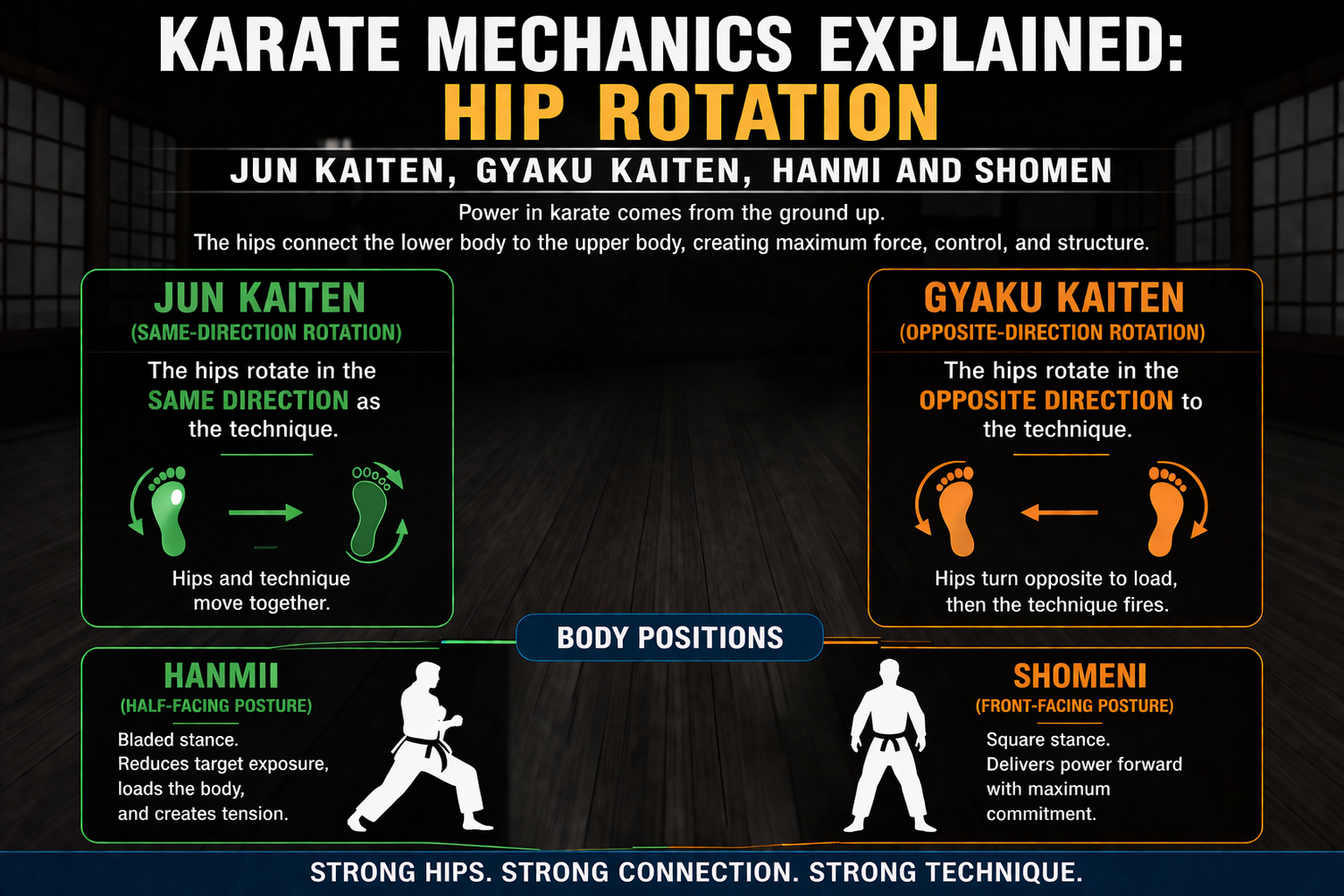
Across martial arts and sport, the ability to rotate the hips well is one of the foundations of power.
You can see it in a javelin throw, a baseball swing, or the delivery of a strong karate technique.
In each case, power is not created by the arms alone. It comes from coordinated force transfer through the feet, legs, hips, torso, and finally into the technique itself.
This is something I focus on heavily in my teaching and training. I do not just teach “karate techniques” as isolated rigid movements. Instead, I teach functional movement principles that help students understand how the body works as one connected system.
Why is it important to understand hip movements?
Hip movement carries across all sports and martial arts. In Karate, this principle is often referred to as hip rotation – Koshi no Kaiten.
At first, students often focus on the arms, the shape of the technique, or the stance. Over time, they begin to realise that what gives a technique life, power, and efficiency is how the hips connect the lower body to the upper body.
Many karate practitioners take years to properly understand this. Many people train hip rotation too rigidly or force it beyond what their structure can support.
If done incorrectly, over time, poor mechanics, repetitive loading, and muscle imbalances can place unnecessary stress on the hips and knees, increasing the risk of overuse problems and joint irritation.
What are the 2 types of hip rotations?
Two important ideas within hip rotation are same-direction rotation – Jun Kaiten and opposite-direction rotation – Gyaku Kaiten.
These are not separate styles of movement.
They are two different ways of using the hips to support striking, parrying, blocking, receiving, and countering.
Both are important. Both have value.
The key is understanding when and why each one is being used.
This is particularly more important in a self defence situation like if you were sitting down in a chair – for instance a car and someone tried to open your door or smash your window and grab you.
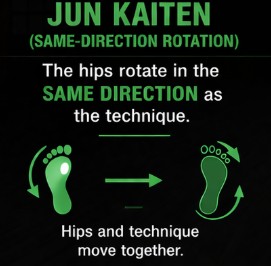
Jun Kaiten
Same-direction rotation happens when the hips rotate in the same direction as the technique.
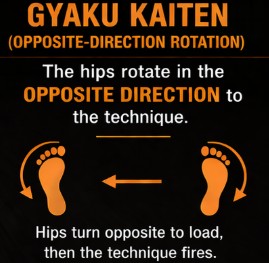
Gyaku Kaiten
Opposite-direction rotation happens when the hips rotate in the opposite direction to the technique.
What is the historical evolution of hip rotation in Karate?
While the terms same-direction rotation Jun Kaiten and opposite-direction rotation Gyaku Kaiten are Japanese karate terminology, the underlying body mechanic is much older.
To understand why this matters, it also helps to look at the older body mechanics that influenced karate’s development.
- Traditional Chinese martial arts placed major importance on using the waist as the control centre of movement and power. In arts such as Taijiquan, the classics describe force being organised from the feet through the legs into the waist, while arts such as Baguazhang emphasise whole-body coordination through waist rotation and leg action.
- As Okinawan karate developed under strong Chinese influence, especially through the long cultural exchange between Okinawa and Fujian, these principles became part of the body method of karate.
- As Karate became Japanese karate, it has been shaped by Bushido – way of the warrior and the broader traditions of Japanese martial arts. Within this framework, ideas such as hip rotation (koshi no kaiten), half-facing posture (hanmi), front-facing posture (shomen), same-direction rotation (jun kaiten), and opposite-direction rotation (gyaku kaiten) were formalised and taught through Japanese terminology.
- Over the past century, karate has continued to evolve through scientific study, kinesiology, and a growing understanding of functional movement and human performance.
How does it work with Bladed and Square Body Positions?
In Japanese Karate, hip rotation is also closely related to the ideas of half-facing posture – Hanmi and front-facing posture – Shomen.
- Half-facing posture – Hanmi is a bladed or half-turned body position.
- Front-facing posture – Shomen is a square, forward-facing body position.
In basic karate training, students are often taught to move between Hanmi and Shomen while keeping the hips level and the upper body connected.
As training becomes more advanced, students may also explore transitions involving Gyaku Hanmi, Shomen, and Hanmi, depending on the school, the kata, and the tactical purpose of the movement.
This is where many people get confused, especially when you add concepts of Jun & Gyaku Kaiten.
- For example, a same-side punch – Jun Zuki or Oi Zuki does not automatically mean it uses same-direction rotation / Jun Kaiten.
- Likewise, a reverse punch – Gyaku Zuki does not automatically mean it uses opposite-direction rotation / Gyaku Kaiten.
The words Jun and Gyaku are describing different relationships depending on the term being used. That distinction matters. If you do not understand what relationship the word is describing, the terminology can become confusing very quickly.
But once you understand that one term may describe the relationship between the limbs, while another describes the relationship between the hips and the technique, things become much clearer.
The late legendary karate master Tetsuhiko Asai said these rotations should not be treated as fixed movements or patterns.
In more advanced karate, the real goal is to choose the hip action that best matches the technique, angle, timing, target, and tactical purpose.
This makes sense in a self defence application.
Sometimes the body rotates more toward half-facing posture – hanmi, sometimes more toward front-facing posture – shomen, and sometimes a blended or double action is used.
The point is to choose the hip action that best matched the technique, angle, timing, target, and tactical purpose.
The TLDR version of this article
A lead-hand punch performed from Hanmi is not automatically one category, and a punch finishing in Shomen is not automatically another.
Same-direction rotation – Jun Kaiten and opposite-direction rotation – Gyaku Kaiten are determined by how the hips move in relation to the technique, not simply the final body position.
Same-direction rotation (Jun Kaiten) = hips turn in the same direction as the technique.
Opposite-direction rotation (Gyaku Kaiten) = hips turn in the opposite direction to the technique.
Half-facing posture (Hanmi) = bladed body position.
Front-facing posture (Shomen) = square body position.
Leave a Reply
You must be logged in to post a comment.